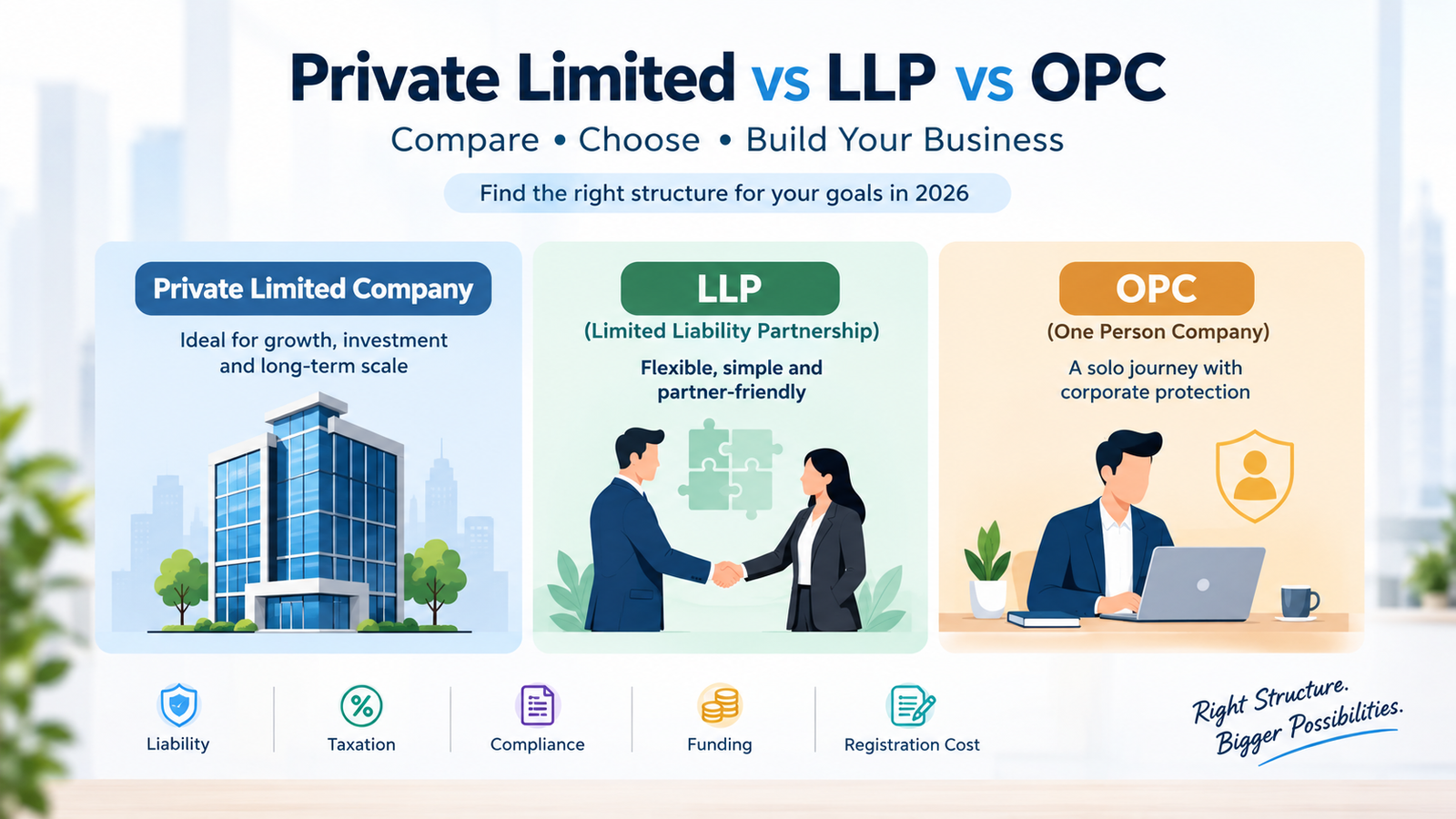
Choosing the right business structure is an important decision for any entrepreneur. It affects ownership, personal liability, taxation, compliance costs and the way your business can raise funds in the future.
In India, three popular options for entrepreneurs are a Private Limited Company, a Limited Liability Partnership (LLP) and a One Person Company (OPC). Each structure serves a different purpose, and the right choice depends on your business model, number of owners, funding plans and long-term goals.
In this guide, we compare Private Limited companies, LLPs and OPCs to help you understand their key differences and choose a structure that suits your business.
Disclaimer: This article provides general information, not personalised legal or tax advice. Applicable laws, tax rates and filing requirements should be checked for your specific circumstances.
Private Limited vs LLP vs OPC: Quick Comparison
Feature | Private Limited Company | LLP | OPC |
Governing law | Companies Act, 2013 | LLP Act, 2008 | Companies Act, 2013 |
Ownership | 2–200 members | At least 2 partners | 1 member and a nominee |
Management | At least 2 directors | At least 2 designated partners | At least 1 director |
Separate legal entity | Yes | Yes | Yes |
Limited liability | Generally, yes | Generally, yes | Generally, yes |
Statutory audit | Generally mandatory annually | Conditional on prescribed thresholds | Generally mandatory annually |
Equity funding | Shares can be issued subject to law | No share capital in the company-law sense | Additional shareholders require conversion |
ESOPs | Available subject to applicable rules | Not through the standard company share-based ESOP structure | Requires conversion to accommodate outside shareholders |
Best suited for | Growth-oriented businesses and startups | Professional firms and partner-led businesses | Single-founder businesses |
The table provides a general overview. Specific eligibility, exceptions, statutory requirements and tax treatment depend on the applicable legislation.

1. Private Limited Company: Best for Growth and External Funding
A Private Limited Company is often suitable for businesses that plan to expand, bring in investors or build a scalable ownership structure.
Under the Companies Act, 2013, a private company generally requires at least two members and two directors. It can have up to 200 members, subject to the applicable statutory conditions.
Key advantages
- Separate legal identity: The company operates as a legal entity distinct from its shareholders.
- Limited liability: Shareholders’ liability is generally limited to the amount unpaid on their shares, subject to applicable legal exceptions.
- Equity funding: The company can issue shares to investors through legally compliant procedures.
- Employee stock options: Eligible companies can implement ESOPs subject to the Companies Act and applicable rules.
- Business continuity: Changes in shareholding do not automatically end the company’s existence.
Compliance requirements
A Private Limited Company has ongoing compliance obligations. These generally include maintaining statutory records, preparing financial statements, filing annual returns and financial statements with the Registrar of Companies, and appointing an auditor.
Companies must also comply with applicable board-meeting, tax and other filing requirements.
Certain eligible companies may qualify as small companies and receive specific compliance relaxations. Eligibility depends on the statutory definition, applicable limits and exclusions in force at the relevant time.
Who should choose a Private Limited Company?
Consider this structure if you plan to:
- Raise funds from angel investors or venture capital funds.
- Issue equity to co-founders or employees.
- Expand into new markets.
- Build a business with a formal shareholding structure.
The additional compliance workload can be worthwhile when outside equity and structured growth are important priorities.

2. LLP: A Practical Option for Partners and Professionals
A Limited Liability Partnership combines elements of a partnership with a separate legal identity and limited liability.
It is governed by the Limited Liability Partnership Act, 2008. An LLP generally requires at least two partners and at least two designated partners, with applicable residency requirements for designated partners.
Key advantages
- Limited liability: Partners are generally not personally liable for the independent acts of other partners, subject to applicable exceptions.
- Flexible management: Partners can define their respective rights, responsibilities and profit-sharing arrangements in the LLP agreement.
- Fewer company-style formalities: An LLP does not follow the same board-meeting and shareholder-meeting framework as a company.
- Suitable for professional services: It can work well for consulting firms, agencies, professional practices and businesses run by partners.
LLP audit and annual filings
An LLP must maintain appropriate books and comply with annual filing requirements, including its annual return in Form 11 and Statement of Account and Solvency in Form 8.
Under the LLP Rules, an LLP is generally exempt from a statutory audit of its accounts if its turnover does not exceed ₹40 lakh or its contribution does not exceed ₹25 lakh. These are alternative exemption tests, not conditions that must both be satisfied. Tax audit requirements are separate and should be assessed independently.
The applicable filing deadlines and requirements should be checked against current MCA rules and notifications.
Where an LLP may be less suitable
An LLP does not have share capital like a company. Consequently, it does not offer the same straightforward equity issuance and standard company ESOP framework used by many venture-backed startups.
Foreign investment in an LLP is also subject to FEMA rules and applicable sectoral conditions.
Who should choose an LLP?
An LLP may be appropriate if you:
- Are starting a professional or consulting business with another partner.
- Want flexibility in sharing profits and managing operations.
- Do not expect to raise conventional equity funding.
- Prefer a partnership-based management structure.
An LLP can be a practical choice, but compare its tax treatment and compliance costs with those of a company before deciding.

3. OPC: A Company Structure for a Single Founder
A One Person Company allows one eligible person to establish a company with a separate legal identity and limited liability.
An OPC can be useful for a founder who wants to operate independently without adding a second shareholder merely to meet the minimum membership requirement of a Private Limited Company.
Key advantages
- Single-member ownership: One eligible person owns the company.
- Separate legal identity: The company is legally distinct from its member.
- Limited liability: The member generally receives liability protection, subject to applicable exceptions.
- Corporate structure: The business can maintain a formal company structure while having one member.
Eligibility and conversion rules
An OPC must comply with the Companies Act, 2013 and the applicable Companies (Incorporation) Rules. A nominee must be designated as required under the rules, and the member must meet the applicable eligibility conditions.
The 2021 amendments changed OPC eligibility and removed the earlier mandatory-conversion thresholds based on paid-up capital and turnover. Therefore, older articles stating that an OPC must convert solely because it crosses the previous ₹50 lakh capital or ₹2 crore turnover limits may be outdated.
An OPC can convert into another eligible company structure in accordance with the applicable rules and filing requirements.
What are the limitations of an OPC?
An OPC has only one member. It cannot simply issue shares to another shareholder while continuing as an OPC; conversion is required to accommodate additional shareholders.
It also has company-level compliance obligations, including statutory audit requirements and applicable annual filings. Specific board-meeting relaxations apply under the Companies Act.
Who should choose an OPC?
An OPC may suit you if you:
- Are a solo entrepreneur.
- Want a company structure with one member.
- Prefer to retain individual ownership for now.
- Do not currently need outside equity shareholders.
If you anticipate raising investment soon, compare the cost and process of starting directly as a Private Limited Company against incorporating an OPC and converting later.
4. Taxation: Private Limited Company vs LLP vs OPC
Taxation is an important factor when choosing a business structure, but comparing headline rates alone can lead to the wrong decision.
Taxation of a Private Limited Company and OPC
A Private Limited Company and an OPC are generally taxed as domestic companies, subject to the applicable provisions and eligibility conditions.
A company may qualify for a concessional tax regime if it meets the relevant conditions. The actual tax payable can depend on the applicable regime, deductions, surcharge, cess and other provisions.
Taxation of an LLP
An LLP is generally taxed as a partnership-type entity under the applicable income-tax provisions. Its tax treatment differs from that of a company, particularly when profits are distributed to owners.
The tax treatment of partner remuneration, interest and profit shares must also be considered when calculating the overall cost.
Important: Which tax year are you referring to?
India’s Income-tax Act, 2025 took effect from 1 April 2026. The law uses the term Tax Year for periods beginning under the new Act, while earlier periods continue to be governed by the relevant provisions of the Income-tax Act, 1961.
This means Assessment Year 2026–27 and Tax Year 2026–27 are not interchangeable. Tax rates and eligibility conditions should be verified under the legislation applicable to the period in question.
For a fair comparison, consider expected profits, the amount you plan to withdraw, remuneration, dividends, available deductions and eligibility for concessional regimes. A chartered accountant can calculate the likely tax impact for your business.
5. Registration Cost: Private Limited vs LLP vs OPC
Registration costs depend on the structure, contribution or authorised capital, state stamp duty, digital signatures and professional fees.
Private Limited Company and OPC
Company incorporation is generally completed through the MCA’s SPICe+ process. Eligible incorporations with authorised capital up to ₹15 lakh have historically qualified for a zero MCA incorporation filing fee, but stamp duty and other costs may still apply.
The final amount depends on the current filing rules, the state of registration and the services included in the professional fee.
LLP
An LLP’s incorporation fees depend on the applicable contribution-based fee structure. Stamp duty on the LLP agreement varies by state, and the agreement must be filed with the MCA within the prescribed period.
Don’t compare registration fees alone
Your ongoing compliance expenditure also matters. A company generally has annual statutory audit and corporate filing obligations, while an LLP may qualify for an audit exemption under the applicable thresholds.
Ask for a complete estimate that includes incorporation, professional services, annual filings, accounting, audit and tax compliance before making your decision.
6. How to Choose the Best Business Structure in India
The best structure depends on your ownership requirements, funding plans and operational priorities.
- Choose a Private Limited Company if you plan to raise equity, issue ESOPs or build a business with multiple shareholders.
- Choose an LLP if two or more partners want a flexible operating structure, particularly for professional or service-based businesses.
- Choose an OPC if you are a solo founder who wants a company structure with one member and does not currently need outside shareholders.
Also consider whether you expect to add co-founders, how you will compensate owners, your preferred compliance workload and whether future investors may require a particular structure.
There is no universally best option. The right decision is the one that aligns with your business goals and remains practical as your business grows.
7. Get Professional Guidance Before Registering
Choosing a business structure affects more than your registration documents. It can influence tax planning, ownership, compliance obligations and future fundraising.
At D G Associates, we help businesses understand their registration and compliance requirements so they can make informed decisions.
Explore our services:
Before registering, discuss your business model, expected profits, ownership plans and funding requirements with a qualified professional. This can help you choose a structure that fits both your current needs and your long-term plans.
Sources and References
Use direct official sources and confirm the applicable versions before publication:
- Ministry of Corporate Affairs (MCA) — Companies Act, 2013, LLP Act, 2008, incorporation rules, forms and notifications.
- Income Tax Department — Applicable tax provisions, rates and tax calculation tools.
- Income Tax Department: Tax Estimator guidance — Selecting the correct Act and tax period.
- MCA: SPICe+ incorporation information — Incorporation process and filing-fee guidance.
- Reserve Bank of India — Applicable FEMA provisions and foreign investment rules for LLPs.
FAQs
A Private Limited Company is often more suitable for startups planning to raise equity funding or offer company-based ESOPs. An LLP may work well for a bootstrapped business operated by partners. The best choice depends on your funding plans, compliance needs and tax position.
An eligible Indian citizen who is a non-resident may establish an OPC subject to the applicable Companies (Incorporation) Rules and other eligibility conditions. The 2021 amendments reduced the prescribed residency requirement to 120 days in the relevant financial year. Confirm your eligibility before incorporation.
The earlier mandatory-conversion thresholds based on ₹50 lakh paid-up capital and ₹2 crore turnover were removed by the 2021 amendments. Crossing those former thresholds alone does not trigger mandatory conversion. Other applicable legal requirements must still be followed.
An LLP is generally exempt from statutory audit if its turnover does not exceed ₹40 lakh or its contribution does not exceed ₹25 lakh, subject to the applicable rules. Tax audit requirements are separate and may apply depending on the circumstances.
The cost depends on applicable MCA fees, state stamp duty, digital signatures and professional charges. Eligible company incorporations with authorised capital up to ₹15 lakh may qualify for zero MCA incorporation filing fees, but this does not mean the entire registration process is free.
The applicable rate depends on whether you mean Assessment Year 2026–27 or Tax Year 2026–27, the relevant legislation, the company’s eligibility for a particular tax regime and other conditions. Confirm the applicable rate and provisions with a chartered accountant before making a tax decision.