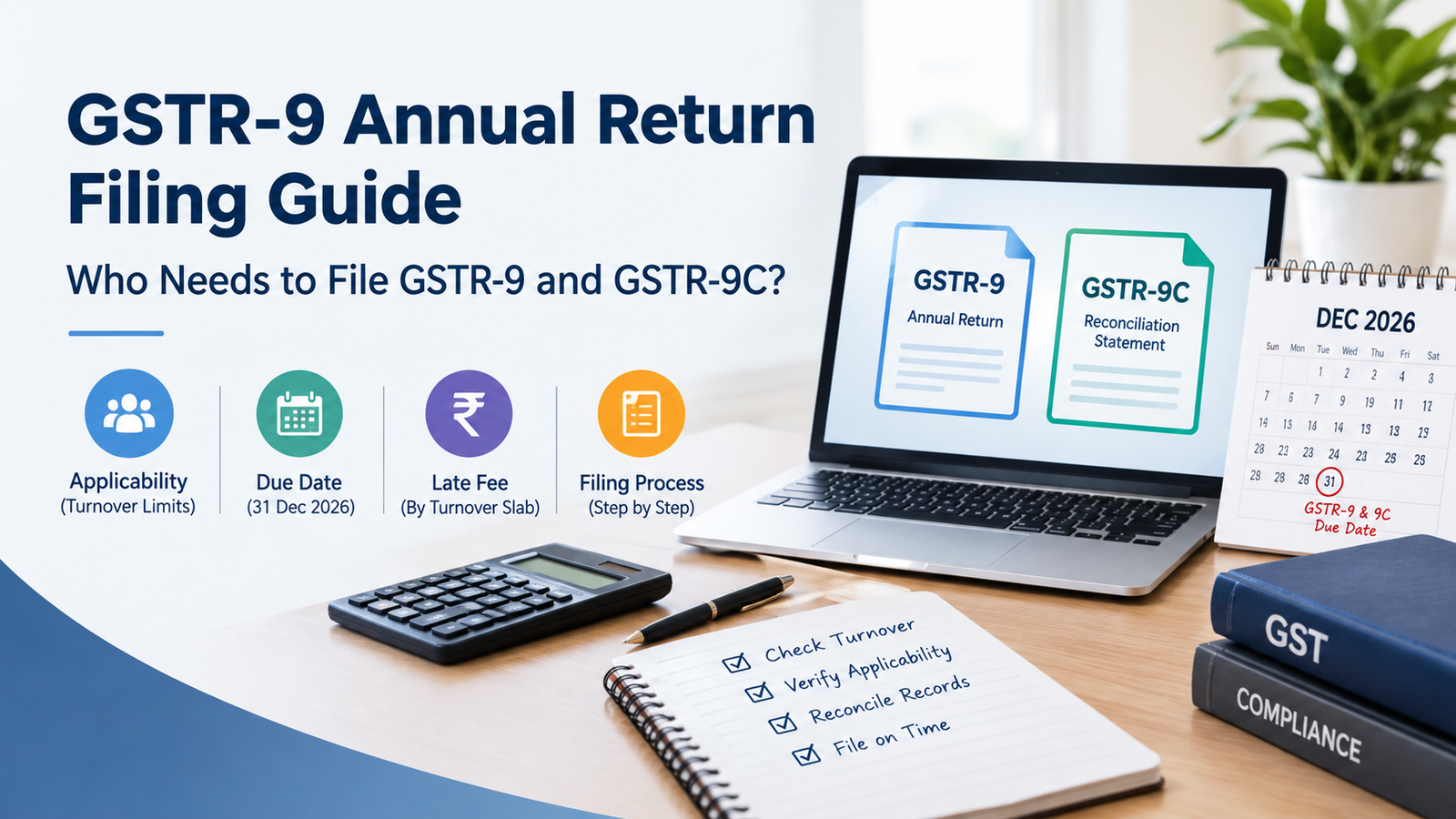
Filing monthly GST returns is an important part of running a compliant business, but your GST obligations do not necessarily end with GSTR-1 and GSTR-3B. Eligible registered taxpayers may also need to file an annual return in Form GSTR-9 and, where applicable, a reconciliation statement in Form GSTR-9C.
Understanding these requirements in advance can help businesses identify discrepancies, review input tax credit (ITC), and avoid unnecessary filing delays.
For FY 2025-26, businesses should review their aggregate turnover, registration details, periodic returns, and applicable exemptions before deciding which annual return forms they need to file.
This guide explains GSTR-9 applicability, GSTR-9C requirements, the statutory due date, late fees, and the steps involved in preparing an annual GST return.
What Is GSTR-9?
GSTR-9 is the annual return prescribed under Section 44 of the Central Goods and Services Tax (CGST) Act, 2017, read with the applicable rules.
It consolidates information relating to a registered taxpayer’s outward supplies, inward supplies, taxes paid, input tax credit claimed, and other relevant details for a financial year.
The return helps taxpayers review the information reported through their periodic GST returns and identify differences that may require attention.
Before filing GSTR-9, businesses should reconcile their books of accounts with GSTR-1, GSTR-3B, available GSTR-2B data, and other supporting records.
Who needs to file GSTR-9?
The requirement to file GSTR-9 depends on the taxpayer’s category, aggregate turnover, and applicable exemptions.
The following table provides a general overview. Confirm the exemption notifications applicable to FY 2025-26 before relying on the turnover thresholds.
|
Aggregate turnover |
General filing position |
|
Up to ₹2 crore |
Check whether an applicable exemption notification covers the financial year. |
|
Above ₹2 crore and up to ₹5 crore |
GSTR-9 is generally applicable, subject to the relevant rules and exemptions. |
|
Above ₹5 crore |
GSTR-9 is generally applicable, and GSTR-9C is also required where the statutory conditions are met. |
Important: The exemption for taxpayers with aggregate turnover up to ₹2 crore must be verified against the applicable government notification for the relevant financial year. Do not assume that an exemption notified for an earlier year automatically applies to FY 2025-26.
How is aggregate turnover calculated?
Aggregate turnover is defined under Section 2(6) of the CGST Act. Broadly, it includes the aggregate value of taxable supplies, exempt supplies, exports, and inter-State supplies of persons having the same PAN, calculated on an all-India basis. It excludes GST and certain other amounts specified in the definition.
For example, suppose a business has the following turnover:
- Gujarat GST registration: ₹90 lakh
- Maharashtra GST registration: ₹70 lakh
- Karnataka GST registration: ₹55 lakh
The aggregate turnover is ₹2.15 crore.
Although none of the individual registrations has turnover exceeding ₹2 crore, the business’s aggregate turnover under the same PAN exceeds that threshold.
This distinction is important when determining annual return applicability. Businesses operating in multiple states should calculate aggregate turnover across their registrations rather than examining each GSTIN in isolation.
Taxpayers under the composition scheme generally follow the applicable composition-return requirements, including Form GSTR-4, rather than filing GSTR-9. The precise obligations should be checked against the rules applicable to their registration and circumstances.

What Is GSTR-9C? Understanding Its Applicability
GSTR-9C is the reconciliation statement associated with the annual GST return. It helps reconcile the information reported in GSTR-9 with the taxpayer’s financial statements and books of accounts.
It is particularly relevant for businesses whose aggregate turnover exceeds ₹5 crore during the financial year, subject to the applicable statutory requirements.
For example, if a business reports turnover of ₹8 crore in its financial statements but the turnover reported in its GST returns differs, the reconciliation process helps identify and explain the difference.
Possible reasons for discrepancies include:
- Differences in the timing of revenue recognition
- Credit notes and debit notes
- Differences between accounting records and GST reporting
- Errors in classifying taxable and exempt supplies
- Differences in input tax credit figures
- Amendments or adjustments relating to earlier reporting periods
Does GSTR-9C require certification by a CA?
GSTR-9C moved to a self-certified reconciliation statement from FY 2020-21 following the relevant amendments.
Therefore, the earlier requirement for certification by a chartered accountant or cost accountant should not be presented as the general current requirement.
However, self-certification does not eliminate the need for a proper reconciliation. Businesses should maintain supporting documents and ensure that the figures reported in the statement are accurate and explainable.
A qualified tax professional can assist with reviewing the reconciliation, identifying discrepancies, and evaluating any additional tax liability.
What Is the GSTR-9 Due Date for FY 2025-26?
Under Section 44 of the CGST Act, read with the applicable rules, the general statutory due date for furnishing the annual return is 31 December following the end of the relevant financial year, unless extended by the government.
For FY 2025-26, the statutory due date is therefore 31 December 2026, subject to any applicable extension notified by the government.
Businesses should check the latest CBIC notifications and GST portal advisories before filing to confirm whether any extension or special instruction applies.
Waiting until the final days can leave insufficient time to resolve differences between books, periodic returns, and supporting documents.
A practical approach is to begin the reconciliation well before the deadline and keep sufficient time for review and correction.
Input Tax Credit: What Should You Check Before Filing?
Input tax credit is an important part of annual GST reconciliation. Before filing GSTR-9, businesses should review the credit claimed during the year and identify any discrepancies that need attention.
Section 16(4) of the CGST Act generally sets the time limit for claiming eligible ITC relating to a financial year as 30 November following the end of that financial year, or the date of furnishing the relevant annual return, whichever is earlier, subject to applicable exceptions.
For FY 2025-26, the general date under this provision is 30 November 2026. The applicable deadline should be assessed carefully before filing the annual return.
ITC reconciliation checklist
Before finalising your annual return, review the following:
- Compare purchase registers with the available GSTR-2B data.
- Reconcile the eligible ITC claimed in GSTR-3B with your books.
- Review credit notes, debit notes, reversals, and adjustments.
- Identify differences between the credit reflected in records and the credit actually claimed.
- Check the supporting documents and eligibility conditions for the credits claimed.
- Resolve outstanding ITC issues within the applicable statutory timelines wherever possible.
GSTR-2B is an important reconciliation source, but the appearance of an invoice in the statement does not by itself establish that the credit is eligible. Businesses must also satisfy the applicable ITC conditions.
What Should Businesses Review for FY 2025-26?
Preparing an annual return involves more than copying figures from previously filed returns. Businesses should review whether their GST reporting agrees with their accounting records and whether any discrepancies remain unresolved.
1. Reconcile sales and outward supplies
Compare the sales register with GSTR-1 and the corresponding liability reported in GSTR-3B.
Review credit notes, amendments, exempt supplies, exports, and other relevant transactions to ensure that the annual figures are consistent with the supporting records.
2. Reconcile purchases and input tax credit
Compare purchase records, available GSTR-2B data, and ITC claimed through periodic returns.
Identify ineligible credits, reversals, and differences that require explanation or correction.
3. Review tax rates and classifications
Review the applicable GST rates and classifications for the supplies made during the year.
Where rates changed during the financial year, check the relevant effective dates and notifications against the transactions concerned. Do not rely solely on the rate configured in accounting software.
4. Check outstanding liabilities
Identify any differences that may result in additional tax, interest, or other amounts payable.
Evaluate the appropriate correction or payment mechanism under the applicable GST provisions. Where additional liability is identified, a tax professional can help determine the correct procedure before the annual return is submitted.
5. Maintain supporting documentation
Keep the sales register, purchase register, financial statements, tax payment records, reconciliation workings, and relevant invoices readily available.
Proper documentation makes the review easier and supports the explanations provided for differences between accounting records and GST returns.

GSTR-9 Late Fee: Rates and Maximum Limits
Late fees may apply when the annual return is furnished after the applicable due date. The amount depends on the statutory provisions and the applicable turnover-based relief.
Notification No. 07/2023-Central Tax dated 31 March 2023 introduced a rationalised late-fee structure for GSTR-9 for the relevant financial years, subject to its conditions.
The following table summarises the notified turnover-based structure. Confirm its applicability to FY 2025-26 and check for subsequent amendments before calculating the amount payable.
Aggregate turnover | Combined late fee per day | Maximum combined late fee |
Up to ₹5 crore | ₹50 per day | 0.04% of aggregate turnover |
Above ₹5 crore and up to ₹20 crore | ₹100 per day | 0.04% of aggregate turnover |
Above ₹20 crore | ₹200 per day under the general statutory rate | Generally up to 0.50% of aggregate turnover under Section 47(2) |
For the first two turnover categories, the notified daily amount comprises the relevant CGST and SGST components where applicable. The exact tax components and the treatment of a particular registration should be checked for the taxpayer’s circumstances.
For taxpayers required to furnish GSTR-9C, the annual return may not be treated as complete until both GSTR-9 and the applicable GSTR-9C have been furnished. CBIC Circular No. 246/03/2025-GST clarifies the treatment of late fees in these circumstances.
Accordingly, taxpayers should not assume that filing GSTR-9 alone necessarily completes their annual return obligations when GSTR-9C is also required.
How to File GSTR-9 Online: Step-by-Step Process
Once the applicable filing requirements have been confirmed and the records reconciled, businesses can proceed with the annual return.
Step 1: Complete the periodic returns
Ensure that the required GSTR-1 and GSTR-3B returns for the relevant financial year have been filed. Check the latest portal instructions for any additional prerequisites.
Step 2: Reconcile the books of accounts
Compare the sales register, purchase register, financial statements, tax payments, and ITC records with the figures reported in periodic GST returns.
Investigate discrepancies before proceeding.
Step 3: Log in to the GST portal
Visit the official GST portal at gst.gov.in and log in using your registered credentials.
Navigate to Services, then Returns, and then Annual Return. Select FY 2025-26, subject to the availability of the relevant form on the portal.
Step 4: Review the auto-populated figures
Check the auto-populated information carefully against your books and filed returns.
Auto-populated figures are based on the information available to the system; they should not automatically be treated as correct without reconciliation.
Step 5: Resolve discrepancies and outstanding liabilities
Review differences in turnover, tax liability, and ITC.
Where an additional liability is identified, determine the appropriate method for payment and reporting under the applicable GST provisions before filing.
Step 6: Preview and verify the return
Review the completed return and supporting reconciliations. Check the financial year, registration details, tax figures, and other relevant information.
Step 7: Submit the annual return
Submit the return through the prescribed portal process and retain the acknowledgement and supporting records.
GSTR-9 generally cannot be revised after filing. Therefore, careful review before submission is essential.
Step 8: Complete GSTR-9C where applicable
If your business is required to furnish GSTR-9C, prepare the reconciliation statement using the finalised annual return figures and your books of accounts.
Ensure that the applicable annual return obligations are fully completed.
Common Mistakes to Avoid When Filing GSTR-9
Businesses can reduce compliance issues by paying attention to the following common mistakes:
- Calculating turnover separately for each GSTIN instead of considering aggregate turnover under the same PAN.
- Assuming that an exemption applicable to one financial year automatically applies to another.
- Relying only on auto-populated figures without checking the books of accounts.
- Treating all credits appearing in GSTR-2B as eligible ITC.
- Overlooking credit notes, amendments, reversals, and differences between GSTR-1 and GSTR-3B.
- Ignoring the requirement to furnish GSTR-9C when applicable.
- Waiting until the last minute to reconcile records and prepare the annual return.
- Filing without reviewing the final preview and supporting documents.
Addressing these issues early can help businesses complete the filing process with fewer avoidable discrepancies.
How D G Associates Can Help With GST Annual Return Filing
Preparing a GST annual return requires careful reconciliation of accounting records, periodic GST returns, tax payments, and input tax credit.
D G Associates can assist businesses with reviewing their GST records, identifying reporting discrepancies, reconciling ITC, and preparing the information required for annual return compliance.
Our support can help businesses understand their filing obligations, organise the necessary records, and address potential issues before submitting their returns.
If your business has multiple GST registrations, differences between accounting figures and GST returns, or uncertainty about GSTR-9C applicability, a professional review can help clarify the next steps.
Need Help With GSTR-9 or GSTR-9C Filing?
Get in touch with D G Associates for assistance with GST return filing, annual return preparation, and reconciliation support.
Visit our website: https://dgassociatesindia.com/
FAQs
Not necessarily. Applicability depends on the relevant financial year and the exemption notifications in force. Check the applicable notification for FY 2025-26 before deciding whether filing is mandatory or optional.
GSTR-9C generally applies to registered taxpayers whose aggregate turnover exceeds ₹5 crore during the relevant financial year, subject to the applicable statutory requirements.
GSTR-9C has been self-certified since FY 2020-21 under the relevant amendments. However, taxpayers should maintain proper supporting records and ensure that the reconciliation is accurate
The general statutory due date is 31 December 2026, subject to any applicable extension notified by the government.
GSTR-9 generally cannot be revised after submission. Taxpayers should reconcile their records, verify the figures, and review the final return before filing.
GSTR-9 is the annual GST return summarising relevant transactions and tax information for a financial year. GSTR-9C is a reconciliation statement comparing the annual return with the taxpayer’s financial statements and books of accounts. It is required for taxpayers meeting the applicable turnover and statutory conditions.
Composition taxpayers generally follow the applicable composition-return requirements, including Form GSTR-4, rather than filing GSTR-9. Confirm the requirements applicable to the taxpayer’s registration and financial year.
Businesses should prepare their sales and purchase registers, financial statements, GSTR-1 and GSTR-3B returns, available GSTR-2B data, ITC workings, tax payment records, and reconciliation statements.
Late fees may apply under Section 47 of the CGST Act and the applicable notifications. The amount depends on the taxpayer’s circumstances, applicable turnover-based limits, and the duration of the delay.
Although the portal process and filing requirements should be checked for the relevant year, it is best to reconcile ITC and review outstanding discrepancies before submitting the annual return. This helps reduce the risk of errors and missed compliance deadlines.