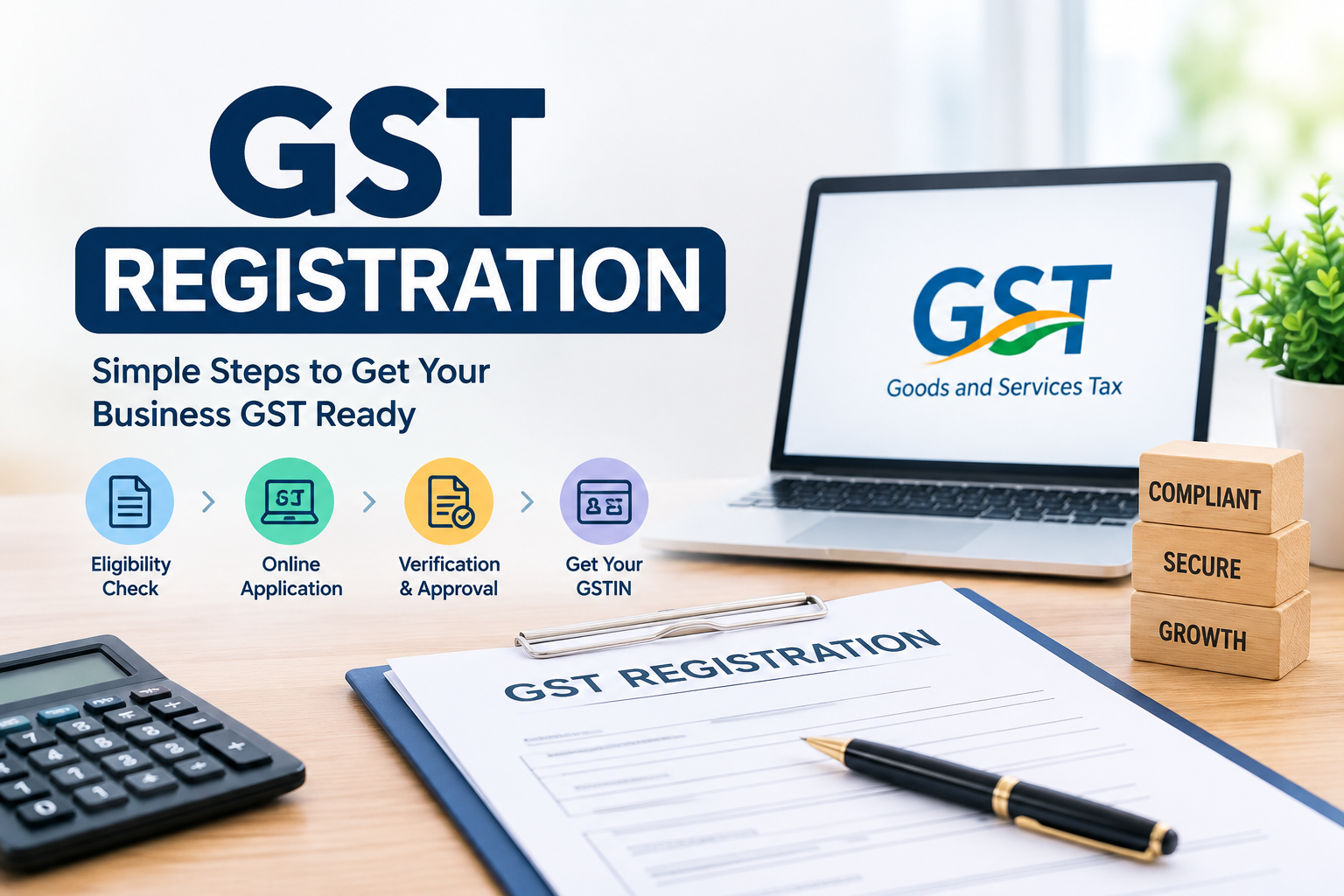
What Is GST Registration? Meaning, Eligibility, Benefits, Documents and Process (2026 Guide)
Starting a business is never just about the product, the customers or the first sale. At some point, almost every founder in India runs into the same question: what is GST registration, do I actually need it, and what happens if I skip it?
GST Registration is the process by which a person or business becomes a recognised taxpayer under the Goods and Services Tax law. Once approved, the applicant receives a unique Goods and Services Tax Identification Number, or GSTIN, along with a registration certificate in Form GST REG-06, downloadable from the official GST Portal. That’s the short answer to what is GST registration. The longer answer is that it’s more than a number on a certificate. Registration brings ongoing obligations too: raising GST-compliant invoices, filing periodic returns, paying tax on time, and maintaining proper records.
This guide walks through who needs to register, who doesn’t, what documents and steps are involved in 2026, and where Gurugram-based businesses in particular should be careful. If you run a small operation and have been putting off the question of what is GST registration and whether it applies to you, this is a good place to get the full picture before you decide. GST for small businesses in particular tends to raise more questions than clear answers online, so we’ve tried to cover the practical side here rather than just the legal text.
Table of Contents
1. What Is GST Registration, Exactly?
2. Who Needs GST Registration in 2026?
3. Turnover-Based Registration Limits
4. Registration Required Regardless of Turnover
5. When Is GST Registration Not Required?
6. Should You Register for GST Voluntarily?
7. Benefits and Business Advantages of GST Registration
8. Documents Required for GST Registration9. The GST Registration Process in 2026, Step by Step
10. Common Reasons Applications Get Delayed or Rejected
11. GST Registration for Freelancers and Consultants
12. GST Registration for E-Commerce Sellers
13. GST Registration in Gurgaon (Gurugram)
14. Why Work With G Dinesh and Associates
15. Frequently Asked Questions (FAQs)
What Is GST Registration, Exactly?
A person registered under GST is legally recognised as a taxable entity. That status carries specific rights and duties: the ability to collect and remit GST, to issue tax invoices, to claim Input Tax Credit on business purchases, and the obligation to file returns such as GSTR-1 and GSTR-3B (or the relevant composition scheme returns) and maintain books of account.
Whether a particular business needs to register depends on a mix of factors: aggregate turnover, whether it supplies goods or services or both, the state it operates from, and whether it falls into a category that must register regardless of turnover. Getting this assessment right at the outset avoids two equally costly mistakes, registering too early and taking on compliance you didn’t need yet, or registering too late and facing interest and penalties on tax that should have been charged all along.
Who Needs GST Registration in 2026?
Turnover-Based Registration
| Category | Threshold |
| Goods suppliers, most states, including Haryana | ₹40 lakh* |
| Goods suppliers, special category states (North-East, Himachal Pradesh, Uttarakhand, etc.) | ₹20 lakh |
| Service providers and mixed suppliers, most states, including Haryana | ₹20 lakh |
| Service providers, special category states | ₹10 lakh |
Turnover is calculated on an all-India, same-PAN basis, not separately for each state or line of business, and it includes taxable, exempt, export and inter-state supplies. GST itself, along with inward supplies taxed under reverse charge, is excluded from this calculation. Once turnover crosses the applicable limit, the law gives you 30 days to apply. Businesses sitting close to the line are better off tracking turnover monthly rather than waiting for year-end numbers to catch them off guard.
Registration Required Regardless of Turnover
Under Section 24 of the CGST Act, certain categories must register no matter how small their turnover is:
- Anyone making inter-state taxable supplies of goods or services
- Casual taxable persons and non-resident taxable persons
- Persons liable to pay tax under the reverse charge mechanism
- E-commerce operators, and, with a narrow exception covered later, suppliers who sell through them
- Input service distributors and persons required to deduct TDS or collect TCS
- Agents supplying goods or services on behalf of another registered person
- Suppliers of OIDAR services from outside India to unregistered persons in India
- Any other category the government notifies from time to time
When Is GST Registration Not Required?
Registration generally isn’t mandatory when turnover stays below the threshold and none of the compulsory categories above apply. A few other situations are worth knowing:
Agriculturists, for the supply of produce out of cultivation of land, are outside the registration requirement for that activity. Businesses dealing wholly in exempt or nil-rated supplies generally don’t need to register for that portion of their activity. If all your supplies are covered under reverse charge, where the recipient pays the tax instead of you, registration isn’t triggered on that basis alone.
Since October 2023, small intra-state sellers of goods on e-commerce platforms, below the applicable threshold and selling within a single state, can trade using an enrolment number instead of a full GSTIN, subject to conditions. This is a narrow relaxation, not a blanket exemption for anyone selling online, and it’s worth returning to when we get to e-commerce sellers below.
Should You Register for GST Voluntarily?
A business under the threshold can still choose to register, and this is where the question of what is GST registration for small businesses specifically starts to matter. Voluntary registration is common when B2B customers expect a GST invoice, when Input Tax Credit on purchases is meaningful enough to matter, or when a business plans to sell inter-state or expand onto e-commerce platforms soon.
On the upside, B2B buyers and government tenders often prefer, or outright require, GST-registered vendors. You can claim Input Tax Credit on business purchases. Inter-state trade and online marketplaces open up more easily. And there’s a genuine credibility bump when dealing with banks and larger corporates.
The catch is that voluntary registration commits you to the same return-filing calendar as any other registered business, GSTR-1, GSTR-3B or the composition scheme returns, along with the same GST-compliant invoicing and books of account, and ongoing compliance even in slow months. Nil returns still have to be filed.
For GST for small businesses, voluntary registration is a genuine strategic choice, not a formality to rush into. It should be based on your customer base, growth plans, and how much compliance overhead you’re actually ready to take on now versus later.
Benefits and Business Advantages of GST Registration
The most basic benefit is legal recognition. A registered business can issue valid tax invoices, charge GST, and operate inside the GST framework instead of around it.
Then there’s Input Tax Credit, probably the single biggest reason businesses register even before they’re required to. A registered business can claim credit for the GST it pays on business purchases, provided the conditions under GST law are met: the supplier’s invoice details have to match, the supplier has to have filed their own return, and there needs to be proof of the underlying supply. ITC isn’t automatic just because an invoice shows a GST amount; it depends on the whole chain staying compliant.
Registration also buys credibility. Many corporates and government departments only transact with GST-registered vendors, since they need a valid GSTIN to claim their own ITC. It’s also a precondition for supplying across state lines and for listing on most e-commerce platforms.
There’s a quieter benefit too. Registration requires maintaining structured records of sales, purchases and invoices, and reconciling them against GST returns. That discipline tends to expose missing invoices, mismatched GSTINs or unclaimed credit early, rather than at year-end when it’s harder to fix.
And, of course, registering when required and staying current with filings avoids the ₹10,000 penalty (or 10% of the tax due, whichever is higher) for failing to register, along with the interest and late fees that build up around delayed compliance. For anyone still weighing what is GST registration going to cost them versus what it saves them, this is usually where the math tips in favour of registering.
Documents Required for GST Registration
Requirements vary by business structure, so treat this as a checklist to confirm against your specific entity type rather than a one-size-fits-all list.
Common to Every Application
| Document | Notes |
| PAN | Of the individual (proprietorship) or the entity |
| Aadhaar | Of the proprietor, partners, directors or authorised signatory |
| Photograph | Passport-size, of the proprietor, partners or authorised signatory |
| Proof of address of the principal place of business | Ownership document, rent or lease agreement, or a consent letter/NOC with a recent utility bill |
| Bank account proof | Cancelled cheque, first page of the passbook, or a recent statement |
| Proof of business constitution | Partnership deed, LLP agreement, Certificate of Incorporation, etc. |
| Authorisation letter or board resolution | Where a signatory is acting on behalf of others |
| Mobile number and email ID | Aadhaar-linked, wherever OTP-based authentication is used |
Additional Documents by Entity Type
| Entity | Extra Documents Typically Needed |
| Proprietorship | Usually just the common list above. A residential address and personal bank account can often be used if names match the PAN |
| Partnership firm | Partnership deed, PAN of the firm, and identity/address proof of each partner |
| LLP | Certificate of Incorporation, LLP Agreement, PAN of the LLP, and details of designated partners |
| Private/Public Limited Company | Certificate of Incorporation, MOA/AOA, company PAN, board resolution authorising the signatory, and details of all directors |
A Digital Signature Certificate is mandatory for companies and LLPs. Proprietorships and partnerships can generally complete the application through Aadhaar-based e-signature instead. Documents need to be uploaded in the specified format and size. A scanned document that’s blurry or oversized sounds like a small thing, but it’s one of the most common, entirely avoidable causes of delay.
The GST Registration Process in 2026, Step by Step
Fast-Track Approval: Under the Central Goods and Services Tax (Fourth Amendment) Rules, 2025, notified on 31 October 2025 and effective from 1 November 2025, new Rules 9A and 14A allow low-risk applicants who complete Aadhaar authentication to be approved in as little as three working days, down from the earlier seven-day standard.
- Start a new registration (Part A). On the GST Portal, go to Services, then Registration, then New Registration, and enter basic details: type of taxpayer, state, business name as per PAN, email and mobile. This generates a Temporary Reference Number, valid for 15 days.
- Complete Part B. Provide details of the business, promoters or partners, authorised signatories, place of business, goods or services offered, and bank account information.
- Choose Aadhaar authentication. This single choice largely determines how fast the rest of the process goes. Opting in allows the primary authorised signatory and at least one promoter or partner to complete e-KYC by OTP.
- Upload supporting documents in the required format and size.
- Complete verification. With Aadhaar authentication, most applicants finish via OTP. Where Aadhaar authentication is skipped, or the application is flagged as higher-risk, a visit to a GST Suvidha Kendra for biometric authentication and document verification is required. This has to be completed within 15 days of submitting Part B, or the TRN lapses.
- Get your Application Reference Number (ARN) once the application is validly submitted, and track status on the portal.
- Await the decision. Aadhaar-authenticated, low-risk applications can be deemed approved within about 3 working days if no query is raised under the new Rule 9A/14A framework, and standard Aadhaar-based cases are typically cleared within about 7 working days. Biometric or higher-risk applications can take up to 21 working days, plus up to 7 more days if the officer raises a clarification through Form GST REG-03, which has to be answered in Form GST REG-04.
- Download the registration certificate (Form GST REG-06) once approved, and display it at the principal place of business as required.
Common Reasons Applications Get Delayed or Rejected
Most rejections and clarification notices trace back to a short, avoidable list:
- Legal name, PAN or address details that don’t exactly match official records
- Weak or mismatched address proof, such as an outdated utility bill, no rent agreement, or a missing NOC from the property owner
- Authorisation documents that don’t clearly establish who is signing on the business’s behalf
- Documents uploaded in the wrong format, size, or too unclear to read
- Missing the 15-day Aadhaar or biometric verification window
- The wrong “constitution of business” selected at the outset
GST Registration for Freelancers and Consultants
Freelancers and independent consultants are treated as service providers under GST, so the ₹20 lakh threshold applies (₹10 lakh in special category states), not the ₹40 lakh goods limit. A few situations catch freelancers off guard when they assume what is GST registration going to require of them is the same as it is for a shop or a manufacturer.
Inter-state services trigger registration regardless of turnover. A Gurugram-based consultant billing a client in another state is making an inter-state supply from day one, which removes the threshold protection entirely. Reverse charge on foreign platforms is another trap; freelancers paying for tools like Canva, Adobe, Figma, AWS or Zoom that don’t charge Indian GST can become liable to pay the GST themselves under RCM, again regardless of turnover. OIDAR services carry their own registration rules and are worth checking specifically if your income comes from digital content, SaaS subscriptions or similar online services. Exports of services to foreign clients are zero-rated, typically through a Letter of Undertaking, so registration doesn’t automatically mean a bigger tax bill on that income.
Many freelancers who are technically under the threshold still register voluntarily, mainly to claim ITC on software, equipment and internet costs, and because larger clients increasingly expect a GSTIN before onboarding. This is a pattern we see across GST for small businesses generally, not just among freelancers: the decision to register early often has more to do with who you’re trying to sell to than with turnover alone.
GST Registration for E-Commerce Sellers
The general rule is stricter here than most small sellers expect. Supplying goods or services through an e-commerce operator that collects Tax Collected at Source generally requires GST registration regardless of turnover. The usual ₹40 lakh and ₹20 lakh thresholds don’t apply once you’re selling through a marketplace, which is one of the more common surprises for anyone Googling what is GST registration after already listing products online.
There is a narrower relaxation, though. Since October 2023, an unregistered seller can continue trading on an e-commerce platform without a full GSTIN if all of the following hold: turnover is within the ordinary threshold, all supplies are intra-state, sales happen through the e-commerce operator in a single state only, and the seller has declared their PAN and business details on the common portal and obtained the required enrolment number. Composition scheme dealers can now also sell goods intra-state through e-commerce platforms under a similar relaxation.
One distinction matters here. The exception above is about selling through a marketplace operator, not about selling online in general. A business selling its own goods through its own website, with no marketplace or TCS-collecting operator involved, is assessed under the ordinary turnover and inter-state rules described earlier. It isn’t automatically pulled into the register-from-the-first-rupee category just because the sale happens online.
Where TCS does apply, the operator deducts 1% and deposits it with the government. The seller can then claim this back as credit while filing returns.
GST Registration in Gurugram
For businesses based in Gurugram, the general rules above apply in full. Haryana is a normal category state, so the ₹40 lakh (goods) and ₹20 lakh (services) thresholds are the relevant starting point for GST registration in Gurgaon, not the lower special-category limits that apply elsewhere.
Locally, the most common friction points we see with GST registration in Gurgaon are address proof for co-working spaces and virtual offices, name mismatches between the lease and the promoter’s PAN, and founders assuming a residential address can’t be used. It usually can, for proprietorships and small partnerships, with the right supporting proof. Given how many startups and small teams in the city operate out of shared workspaces, this single documentation issue accounts for a disproportionate share of the delays we see in GST registration in Gurgaon applications.
Not sure whether your business needs to register yet, or want someone to check your documents before you submit? Our GST registration service covers the assessment, the application, and any clarification the department raises, end to end, for businesses across Gurugram and the wider Delhi NCR region.
Why Work With G Dinesh and Associates
ICAI-Registered Chartered Accountancy Practice: We’re an ICAI-registered chartered accountancy practice in Sector 49, Gurugram, and GST registration isn’t something we hand off. It’s supervised, not delegated. Every application is reviewed by a qualified Chartered Accountant before it goes out, not just prepared by junior staff and signed off on the way out the door.
Over 6+ years of practice, we’ve supported 500+ clients, including startups, freelancers, SMEs, schools, hospitals and manufacturing groups across Delhi NCR and PAN India, with GST registration, monthly compliance, business incorporation, and direct and indirect tax advisory, while keeping a clean compliance record throughout. If you’re still working out what is GST registration going to mean for your specific business, or you already know you need it and just want it done right the first time, get in touch and we’ll take it from there.
Frequently Asked Questions
What is GST registration in simple terms?
It’s the process of becoming a recognised taxpayer under India’s Goods and Services Tax law, which gives you a GSTIN, lets you charge and collect GST legally, and requires you to file returns and maintain proper records in return.
What is GST registration in Gurgaon based on, specifically?
Haryana follows the standard national thresholds, ₹40 lakh turnover for goods suppliers and ₹20 lakh for service providers, with registration also required regardless of turnover for inter-state supply, e-commerce sales, and a few other specific categories.
Is GST registration compulsory for every small business?
No. It depends on turnover, the nature of what you sell, and whether you fall into one of the categories that must register regardless of size, such as inter-state suppliers or e-commerce sellers. GST for small businesses is often a voluntary choice below the threshold, taken mainly to claim Input Tax Credit or meet a client’s requirement for a GSTIN.
How long does GST registration actually take in 2026?
Low-risk, Aadhaar-authenticated applications can now be approved within about 3 working days under the rules effective from 1 November 2025. Standard Aadhaar-based applications typically take about 7 working days, and biometric or higher-risk cases can take up to 21 working days.
Who can help with GST registration in Gurgaon?
G Dinesh and Associates, an ICAI-registered chartered accountancy practice in Sector 49, Gurugram, handles GST registration in Gurgaon end to end, from eligibility assessment through application filing and any department clarification.https://www.forbes.com/advisor/business/software/best-ecommerce-platform/