
Income Tax Saving Tips for Salaried Employees
A practical, line-by-line guide to lowering your tax bill legally from choosing the right regime to squeezing every rupee out of Section 80C, 80D, and HRA.
To implement effective income tax saving tips for salaried employees in FY 2026–27, you must first choose the right tax regime. Under the Old Regime, you can invest up to ₹1.5 lakh under Section 80C (PPF, ELSS, EPF), claim up to ₹50,000 under Section 80D for health insurance, and use HRA and home loan benefits. Under the New Regime, you automatically get a ₹75,000 standard deduction, and the Section 87A rebate makes net income up to ₹12 lakh completely tax-free.
On this page
- 01The changing landscape of salary tax
- 02Old vs New Tax Regime, FY 2026–27
- 03Mastering Section 80C deductions
- 04Beyond 80C: other deductions
- 05HRA & home loan tax benefits
- 06Salary tax calculation, step by step
- 07Common tax planning mistakes
- 08Tips for first-time taxpayers
- 09Frequently asked questions
- 10Conclusion & action plan
The Changing Landscape of Salary Tax in India
Earning a regular salary brings financial security, but it also brings the annual stress of seeing tax cuts on your payslip. For working professionals across India, executing timely income tax saving tips for salaried employees is the single best way to protect your hard-earned wealth. With the rollout of the streamlined Income Tax Act, tax administration has evolved rapidly, making proactive income tax planning more critical than ever.
Managing your personal finances requires a clear understanding of the tax laws. The Indian government rewards disciplined savers by offering various avenues for tax saving for salaried employees. However, waiting until March to submit investment proofs to your HR department is a recipe for disaster — last-minute decisions often lead to poor investments that lock up your capital with low returns.
Real tax planning for salaried employees must begin in April, at the start of the financial year. By selecting the correct tax regime and aligning your financial goals with structured tax saving investments, you can legally lower your taxable income. Our direct tax advisory team walks clients through practical, actionable steps every year to help them file smoothly.
Old Tax Regime vs New Tax Regime for FY 2026–27
The most important step in your tax journey is choosing between the old tax regime vs new tax regime. The New Tax Regime remains the default option for all individual taxpayers. If you want to use the Old Regime to claim specific deductions, you must actively choose it when submitting your initial tax declarations to your employer, and again during your final income tax return filing.
The New Regime offers lower tax rates and removes the hassle of tracking investment proofs. The standard deduction for salary now stands at ₹75,000 under the New Regime, compared to ₹50,000 under the Old Regime. An enhanced Section 87A rebate also makes net taxable income up to ₹12 lakh completely tax-free under the New Regime.
The Old Regime, by contrast, keeps higher slab rates but permits a wide array of income tax deductions and exemptions. If you pay high rent, hold a home loan, or invest heavily in long-term instruments, the Old Regime may still work out cheaper. You can verify current slab rates any time on the official Income Tax Department portal.
Tax Slab Comparison — FY 2026–27
| Income Slab (₹) | Old Regime | New Regime |
|---|---|---|
| Up to 2,50,000 | Nil | Nil |
| 2,50,001 – 4,00,000 | 5% | Nil |
| 4,00,001 – 5,00,000 | 5% | 5% |
| 5,00,001 – 8,00,000 | 20% | 5% |
| 8,00,001 – 10,00,000 | 20% | 10% |
| 10,00,001 – 12,00,000 | 30% | 10% |
| 12,00,001 – 16,00,000 | 30% | 15% |
| 16,00,001 – 20,00,000 | 30% | 20% |
| 20,00,001 – 24,00,000 | 30% | 25% |
| Above 24,00,000 | 30% | 30% |
Pros & Cons at a Glance
New Tax Regime
Pros
- Significantly lower tax rates
- Gross income up to ₹12.75 lakh can be tax-free via deductions & rebate
- Zero tracking of investment bills
Cons
- Disallows HRA exemption
- Disallows Section 80C and 80D claims
- No tax incentives for home buyers
Old Tax Regime
Pros
- Rewards deep savings and investments
- High tax deductions for home loans
- Substantial relief if paying high rent
Cons
- 30% tax rate kicks in past ₹10 lakh
- Heavy administrative verification for proofs
- More complex salary tax calculation
Mastering Section 80C Deductions: The Bedrock of Old Regime Savings
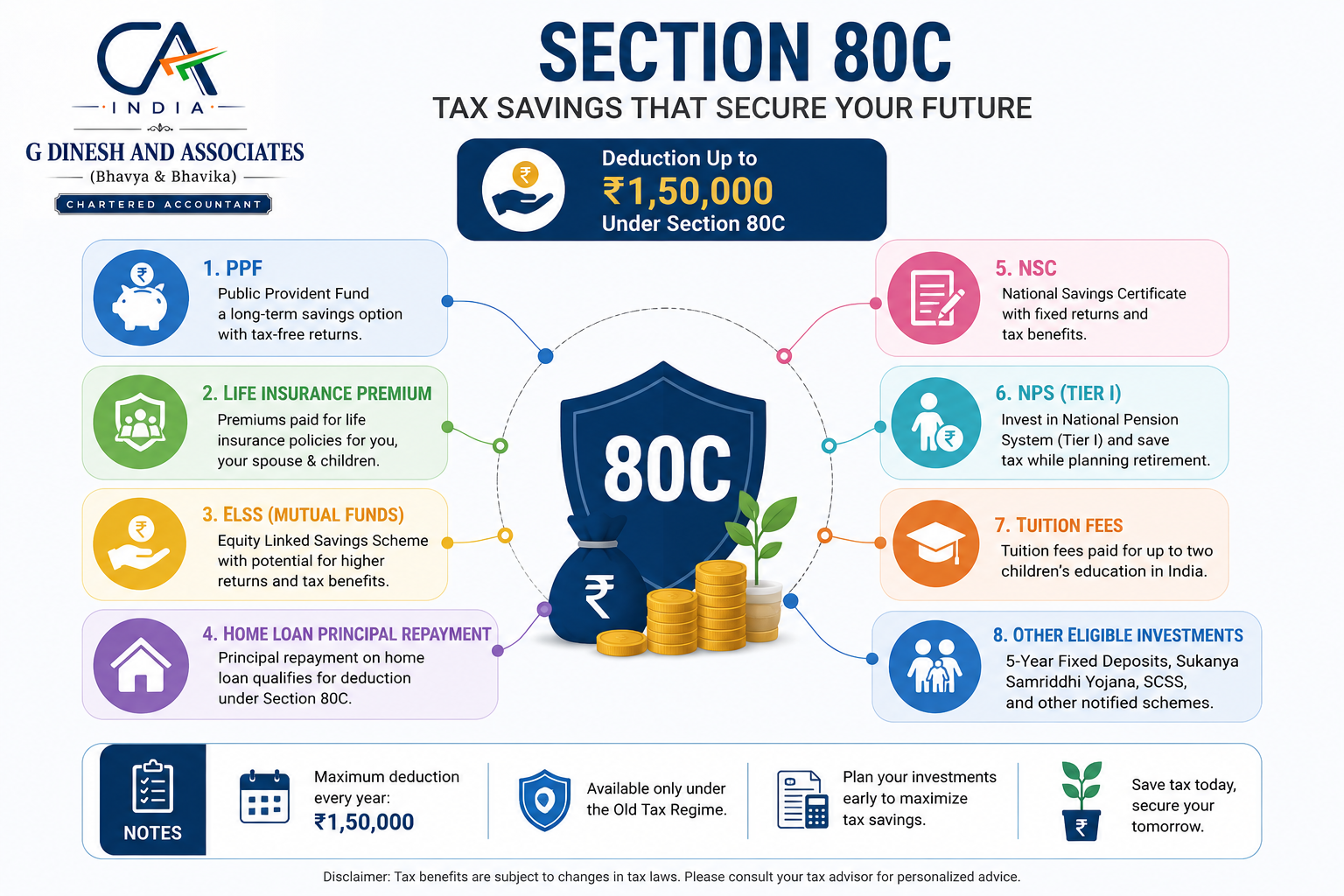
If your analysis leads you to select the Old Tax Regime, maximizing Section 80C deductions is your primary strategy. This section allows a maximum deduction of ₹1,50,000 from your gross total income.
Best Tax Saving Options Under Section 80C
- PPF (Public Provident Fund): a highly secure, government-backed avenue. PPF tax benefits are excellent because it runs on an Exempt-Exempt-Exempt (EEE) framework — principal, accruing interest, and maturity amount all stay tax-free.
- ELSS (Equity Linked Savings Scheme): a good pick for growth-oriented investors. ELSS tax saving funds carry a short three-year lock-in and give you equity market exposure.
- EPF (Employees' Provident Fund): your mandatory monthly contribution, deducted directly by your employer, counts toward the 80C limit.
- NSC & Tax-Saving FDs: fixed-income instruments with a five-year lock-in, suited to conservative investors.
- Tuition Fees: school and university fees paid for up to two children qualify directly under this section.
 Beyond 80C: Essential Deductions to Explore
Smart investors look beyond the basic 80C threshold. The Income Tax Act provides several additional avenues to optimize your position under the Old Tax Regime.
Section 80D — Health Insurance Cushion
Securing medical insurance protects both your family's health and your wallet. Under Section 80D, you can claim deductions on premiums paid via non-cash methods:
| Coverage | Deduction Limit |
|---|---|
| Self, spouse & children | Up to ₹25,000 |
| Dependent parents (below 60) | Additional ₹25,000 |
| Dependent senior citizen parents (60+) | Up to ₹50,000 |
NPS Tax Benefits — Section 80CCD(1B)
The National Pension System offers an extra deduction window. You can claim an autonomous deduction of up to ₹50,000 for voluntary contributions to an NPS Tier-1 account under Section 80CCD(1B) — completely independent of the ₹1.5 lakh limit in Section 80C.
Maximizing Allowances: HRA & Home Loan Benefits
For salaried professionals, allowances built into your compensation structure offer some of the most effective tax shields under the Old Regime.
Navigating the HRA Exemption
If you live in rented accommodation and receive House Rent Allowance, you can claim an exemption under Section 10(13A). The exempt amount is the lowest of these three:
- The actual HRA received from your employer.
- 50% of basic salary + dearness allowance (metro cities) or 40% (non-metros).
- Rent actually paid, minus 10% of basic salary.
Home Loan Tax Benefit Breakdown
Owning a home offers substantial tax advantages. If you've financed a residential property through a home loan, you can use dual benefits:
Step-by-Step Salary Tax Calculation and Strategy
Let's walk through a case study to see how these tips change an individual's real tax liability.
Case Study: Optimizing Anand's Taxes
Anand is a senior software consultant in Bengaluru, earning a gross salary of ₹15,00,000. He pays annual rent of ₹2,40,000 and maximizes his savings. Here's how both regimes compare for him:
| Parameter | New Regime (₹) | Old Regime + Planning (₹) |
|---|---|---|
| Gross Salary | 15,00,000 | 15,00,000 |
| Less: Standard Deduction | 75,000 | 50,000 |
| Less: HRA Exemption | Not allowed | 1,20,000 |
| Less: Section 80C | Not allowed | 1,50,000 |
| Less: Section 80D | Not allowed | 25,000 |
| Less: Section 80CCD(1B) NPS | Not allowed | 50,000 |
| Total Net Taxable Income | 14,25,000 | 11,05,000 |
| Calculated Base Income Tax | 93,750 | 1,44,000 |
| Add: 4% Cess | 3,750 | 5,760 |
| Total Tax Payable | 97,500 | 1,49,760 |
Common Mistakes in Tax Planning for Salaried Employees
Ignoring the default setting. Assuming you're automatically in the Old Regime can lead to unexpected outcomes if you haven't formally submitted your preference to HR.
Mismatched declarations and proofs. Declaring high investment plans via Form 12BB in April but failing to actually invest by Q4 causes heavy tax deductions in February and March.
Chasing returns without considering lock-ins. Investing heavily in long-maturity products without assessing your personal liquidity needs can restrict your cash flow.
Expert Tips for First-Time Taxpayers
- Download and verify your AIS and Form 26AS. Before filing, log into the income tax e-filing portal to match your TDS data against your Form 16.
- Automate your 80C savings. Set up a monthly SIP into an ELSS fund, or schedule automatic transfers to your PPF account, to avoid a year-end scramble.
- Seek professional consultation. Every financial situation is unique — talk to our tax experts to ensure compliance and long-term financial health.
Frequently Asked Questions
Yes, under the New Tax Regime, if your taxable income stays at or below ₹12 lakh, the Section 87A rebate reduces your net tax liability to zero. Combined with the ₹75,000 standard deduction, a gross salary up to ₹12.75 lakh can be completely tax-free if you have no other income streams.
Yes. Salaried employees who do not have business or professional income can switch between the old and new tax regimes every year when filing their ITR.
You must provide signed rent agreements along with monthly rent payment receipts. If your annual rent payments exceed ₹1,00,000, you must also provide your landlord's PAN card to your employer.
Yes. Salaried individuals receive a standard deduction under both systems — ₹75,000 under the New Tax Regime and ₹50,000 under the Old Tax Regime.
No. Deductions for interest paid on a self-occupied property home loan under Section 24b are only available under the Old Tax Regime.
If you miss the internal HR deadline, your employer calculates your remaining salary payments without those deductions, resulting in higher TDS. You can still claim eligible deductions and file for a refund when submitting your final ITR.
Yes. Contributions made by your employer to your NPS account are eligible for deduction under Section 80CCD(2) under both the old and new tax regimes, subject to statutory salary limits.
Yes. Under Section 80D, you can claim an additional deduction of up to ₹25,000 for premiums paid for your parents. If your parents are senior citizens (60 or above), this limit increases to ₹50,000.
No. Capital gains from ELSS mutual funds are taxed as Long-Term Capital Gains (LTCG). Gains above the statutory exempted threshold are subject to applicable capital gains tax rates under the Income Tax Act.
Log into the official Income Tax Department e-filing portal to view your Annual Information Statement (AIS) and Form 26AS. These documents show all tax deductions made against your PAN.
Conclusion & Action Plan
Optimizing your taxes requires consistent planning rather than a last-minute scramble. Whether you benefit more from the lower rates of the New Tax Regime or the targeted deductions of the Old Tax Regime depends entirely on your personal financial situation, income level, and long-term investment goals.
Managing these calculations, verifying your information against your AIS, and selecting the right strategy can be challenging. Working with a professional ensures you stay compliant while keeping more of your hard-earned money.
Take control of your financial future
Contact the team at DG Associates India for personalized tax planning, hassle-free income tax return filing, and financial advisory tailored to your goals.
Talk to a Tax Expert